Some Important Points
Data-Based Economics
Bias vs Variance
- A model is fitted (trained / regressed) on a given amount of data
- A model can be more or less flexible
- have more or less independent parameters (aka degrees of freedom)
- ex: \(y = a + b x\) (2) vs \(y = a + b x_1 + c x_1^2 + e x_2 + f x_3\) (5)
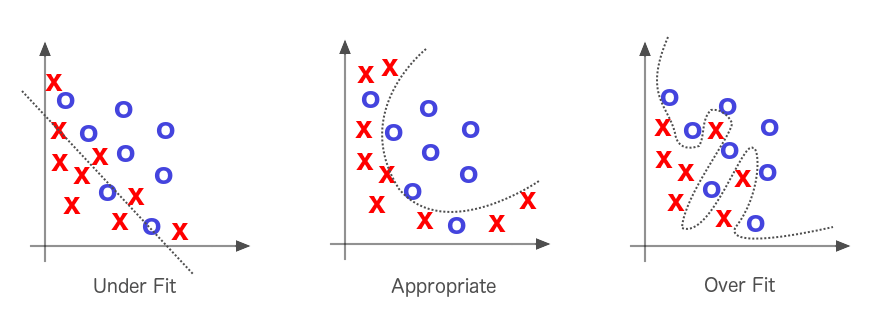
- More flexible models fit the training data better…
- …but tend to perform worse for predictions
- This is known as:
- The Bias (bad fit) vs Variance (bad prediction) tradeoff
- The no free lunch theorem
Overfitting
Explanation vs Prediction
- The goal of machine learning consists in making the best predictions:
- use enough data to maximize the fit…
- … but control the number of independent parameters to prevent overfitting
- ex: LASSO regression has lots of parameters, but tries to keep most of them zero
- ultimately quality of prediction is evaluated on a test set, independent from the training set
- In econometrics we can perform
- predictions: sames issues as ML
- explanatory analysis: focus on the effect of one (or a few) explanatory variables
- this does not necessary require strong predictive power
Read Regression Results
                            OLS Regression Results
==============================================================================
Dep. Variable:                      y   R-squared:                       0.252
Model:                            OLS   Adj. R-squared:                  0.245
Method:                 Least Squares   F-statistic:                     33.08
Date:                Tue, 30 Mar 2021   Prob (F-statistic):           1.01e-07
Time:                        02:34:12   Log-Likelihood:                -111.39
No. Observations:                 100   AIC:                             226.8
Df Residuals:                      98   BIC:                             232.0
Df Model:                           1
Covariance Type:            nonrobust
==============================================================================
                 coef    std err          t      P>|t|      [0.025      0.975]
==============================================================================
Intercept     -0.1750      0.162     -1.082      0.282      -0.496       0.146
x              0.1377      0.024      5.751      0.000       0.090       0.185
==============================================================================
Omnibus:                        2.673   Durbin-Watson:                   1.118
Prob(Omnibus):                  0.263   Jarque-Bera (JB):                2.654
Skew:                           0.352   Prob(JB):                        0.265
Kurtosis:                       2.626   Cond. No.                         14.9
==============================================================================- Understand p-value: chances that a given statistics might have been obtained, under the H0 hypothesis
- Check:
R2: provides an indication of predictive power. Does not prevent overfitting.adj. R2: predictive power corrected for excessive degrees of freedom- global significance (p-value of Fisher test): chances we would have obtained this R2 if all real coefficients were actually 0 (H0 hypothesis)
- Coefficient:
p-valueprobability that coefficient might have been greater than observed, if it was actually 0.- if p-value is smaller than 5%: the coefficient is significant at a 5% level
- confidence intervals (5%): if the true coefficient was out of this interval, observed value would be very implausible
- higher confidence levels -> bigger intervals
Read A Regression Table

Example of a Regression Table
Can there be too many variables?
Overfitting
- bad predictions
Colinearity
- can bias a coefficient of interest
- not a problem for prediction
- exact colinearity makes traditional OLS fail
To choose the right amount of variables find a combination which maximizes adjusted R2 or an information criterium
Colinearity
\(x\) is colinear with \(y\) if \(cor(x,y)\) very close to 1
more generally \(x\) is colinear with \(y_1, ... y_n\) if \(x\) can be deduced linearly from \(y_1...y_n\)
- there exists \(\lambda_1, ... \lambda_n\) such that \(x = \lambda_1 x_1 + ... + \lambda_n x_n\)
- example: hours of sleep / hours awake (sleep=24-awake)
perfect colinearity is a problem: coefficients are not well defined
\(\text{productivity} = 0.1 + 0.5 \text{sleep} + 0.5 \text{awake}\) or \(\text{productivity} = -11.9 + 1 \text{sleep} + 1 \text{awake}\) ?
best regressions have regressors that:
explain independent variable
are independent from each other (as much as possible)
Ommitted Variable
What if you don’t have enough variables?
\(y = a + bx\)
- R2 can be low. It’s ok for explanatory analysis.
- as long as residuals are normally distributed
- check graphically to be sure
- (more advanced): there are statistical tests
omitted variable
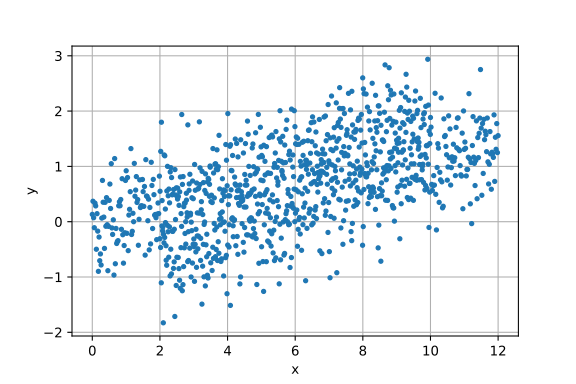
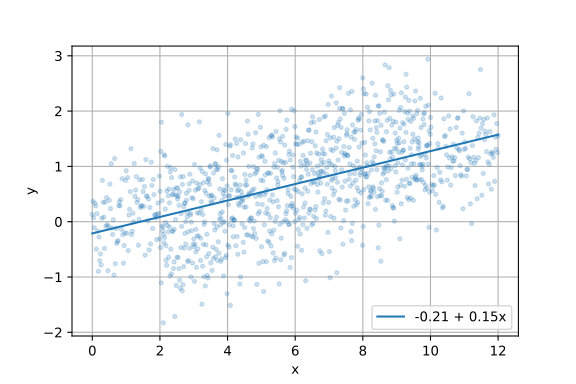
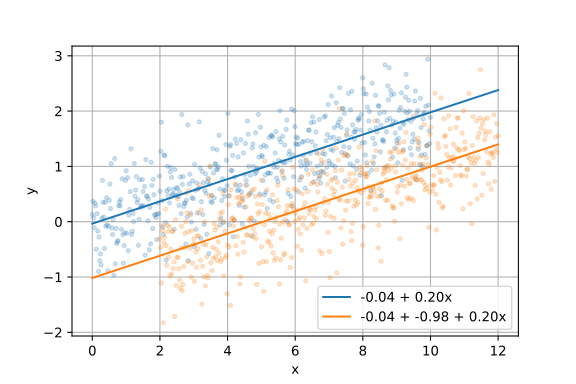
- Suppose we want to know the effect of \(x\) on \(y\).
- We run the regression \(y = a + b x\)
- we find \(y = 0.21 + \color{red}{0.15} x\)
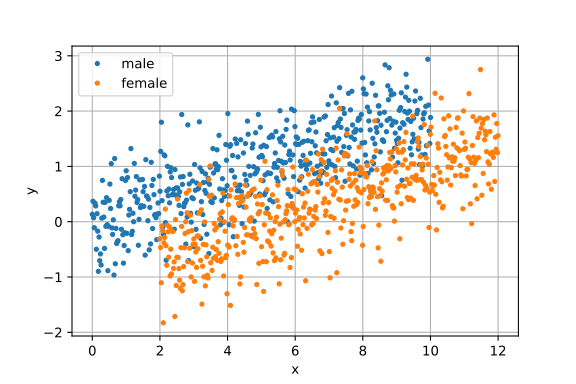
- We then realize we have access to a categorical variable \(gender \in {male, female}\)
- We then add the \(\delta\) dummy variable to the regression: \(y = a + bx + c \delta\)
- we find $ y = -0.04 + x - 0.98 $
- Note that adding the indicator
- improved the fit (\(R^2\) is 0.623 instead of 0.306)
- corrected for the omitted variable bias (true value of b is actually 0.2)
- provided an estimate for the effect of variable gender
Endogeneity
- Consider the regression model \(y = a + b x + \epsilon\)
- When \(\epsilon\) is correlated with \(x\) we have an endogeneity problem.
- we can check in the regression results whether the residuals ares correlated with \(y\) or \(x\)
- Endogeneity can have several sources: omitted variable, measurement error, simultaneity
- it creates a bias in the estimate of \(a\) and \(b\)
- We say we control for endogeneity by adding some variables
- A special case of endogeneity is a confounding factor a variable \(z\) which causes at the same time \(x\) and \(y\)
Instrument
\[y = a + b x + \epsilon\]
- Recall: endogeneity issue when \(\epsilon\) is correlated with \(x\)
- Instrument: a way to keep only the variability of \(x\) that is independent from \(\epsilon\)
- it needs to be correlated with \(x\)
- not with all components of \(\epsilon\)
- An instrument can be used to solve endogeneity issues
- It can also establish the causality from \(x\) to \(y\):
- since it is independent from \(\epsilon\), all its effect on \(y\) goes through \(x\)